

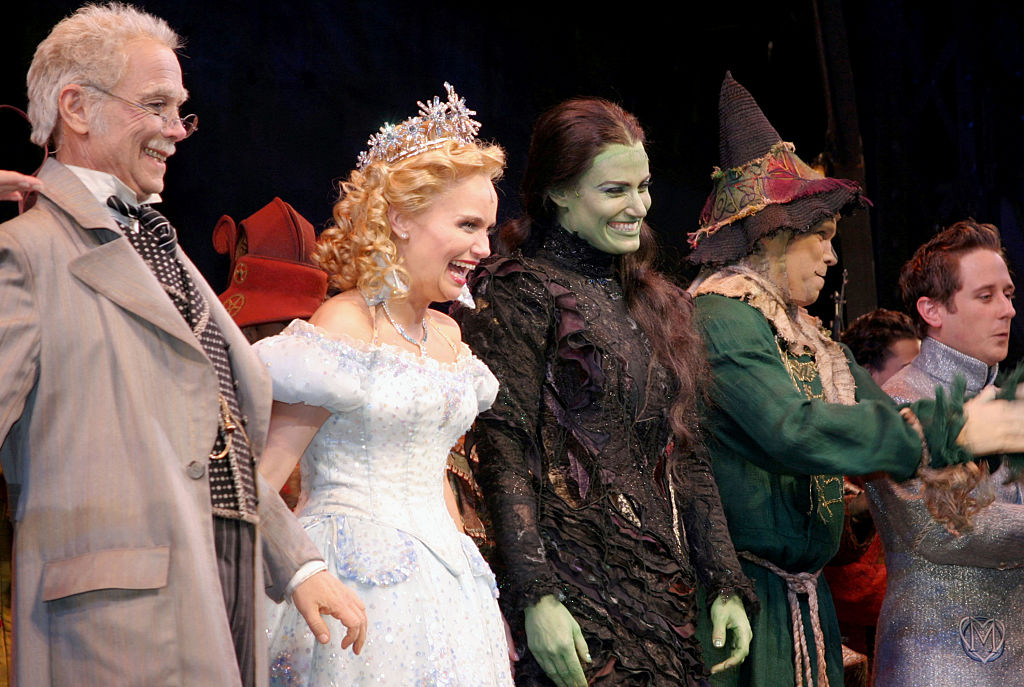
03 Oct Wicked: The Musical That Almost Wasn’t
A chance conversation, a story destined for the movies, an out-of-town tryout, and three months of rewriting helped create one of Broadway’s most enduring musicals.
Today, it is difficult to imagine Wicked as anything other than a phenomenon. Since opening at Broadway’s Gershwin Theatre on October 30, 2003, the musical has become one of the most successful productions in Broadway history, been seen by audiences around the world, and eventually made the journey to the screen.
But before Wicked became Wicked, it was simply an idea — and one Stephen Schwartz encountered almost by accident.
It Started After a Snorkeling Trip
Schwartz was on vacation when folk singer Holly Near told him about a book she was reading: Gregory Maguire’s 1995 novel, Wicked: The Life and Times of the Wicked Witch of the West. The idea was irresistible. Maguire had taken a character almost everyone knew — the Wicked Witch of the West from L. Frank Baum’s Oz stories — and asked readers to see her differently. What if the woman we had always understood to be the villain had her own story? What if there was another side to what happened in Oz?
Schwartz immediately saw the theatrical possibilities. There was just one problem: the rights were already taken.
Wicked Was Headed for the Movies
Universal Pictures had acquired the rights to Maguire’s novel and was developing it as a film. For Schwartz, that could easily have been the end of the story. Instead, he became convinced that Wicked should be a musical.
He pursued the idea with Universal and producer Marc Platt, who had been involved with the planned film adaptation. In a wonderfully theatrical coincidence, Platt already knew Schwartz’s work particularly well: years earlier, while a student at the University of Pennsylvania, he had appeared in a production of Schwartz’s Godspell.
Eventually, Schwartz persuaded Platt and Universal to reconsider. The movie would wait. Wicked would become a stage musical first.
But securing the rights was only the beginning. Schwartz and book writer Winnie Holzman still had to figure out exactly what their musical was about.
Finding the Story
Maguire’s Wicked is a sprawling and often dark novel filled with politics, religion, morality, and questions about the nature of good and evil. Putting all of that onstage wasn’t practical — nor was it necessarily the musical Schwartz and Holzman wanted to write.
As they developed the piece, something began to emerge as its emotional center: the relationship between Elphaba and Glinda. The future Wicked Witch of the West and the future Good Witch weren’t simply opposing characters anymore. They were two young women who meet, dislike each other, become unlikely friends, change one another, and ultimately make very different choices.
That relationship gave the musical its heart. But discovering the heart of a show on paper is different from discovering whether it works in a theatre. For that, Wicked needed an audience.
Then Came San Francisco
In 2003, Wicked received its pre-Broadway production at San Francisco’s Curran Theatre. Many of the elements audiences now associate with the musical were already there. Idina Menzel played Elphaba. Kristin Chenoweth was Glinda. Joe Mantello directed. Audiences responded.
But the creative team also learned that the show wasn’t finished. One concern was particularly important: Glinda was connecting strongly with audiences, while Elphaba — the character at the center of the story — wasn’t yet coming through as clearly as the writers wanted.
Holzman did not believe the problem was Idina Menzel. She believed the problem was the writing. That distinction matters. Rather than asking the actor to somehow solve a problem the material had created, the writers went back to the material.
And fortunately, they had something every developing musical desperately needs: time.
Three Months That Changed Wicked
The producers had built approximately three months into the schedule between the San Francisco production and Broadway. Holzman and Schwartz used them.
They examined what they had learned in front of an audience and went back to work. Scenes were changed. Characters were clarified. Material was rewritten and new material was created. Holzman later described the extent of the work in striking terms: she had changed something on every page of the script.
Interestingly, people who had seen the production in San Francisco and then saw it again in New York sometimes couldn’t identify exactly what was different. But the cumulative effect of hundreds of changes could be enormous.
That is one of the peculiar things about developing a musical. Sometimes the breakthrough isn’t one new song or one brilliant new scene. It is a hundred smaller discoveries — a line changed here, a motivation clarified there, a scene shortened, a character given another moment, a transition made cleaner. Individually, they may seem small. Together, they can change the entire experience.
Broadway — October 30, 2003
Wicked began previews at the Gershwin Theatre in October 2003 and officially opened on October 30. Even then, its future was hardly assured. The critical reception was mixed. Some reviewers praised its performances and theatrical spectacle while raising questions about the show itself.
Audiences had other ideas. They came — and kept coming.
What had begun with a conversation about an unusual novel became one of the defining musicals of its generation.
The Musical We Know Wasn’t Inevitable
Looking backward can distort the way we think about successful musicals. Once a show has run for years, toured the world, entered popular culture, and been adapted into a major motion picture, its success can seem almost preordained.
It wasn’t. There was a moment when Stephen Schwartz didn’t control the rights to Wicked. There was a moment when nobody knew whether a sprawling novel about the Wicked Witch of the West could become a musical. There was a version in San Francisco that its creators knew still needed work. And there were three months when the people who had created it could have decided it was good enough.
Instead, they kept working. They listened, learned, and rewrote. And on October 30, 2003, the curtain rose on Broadway.
Before Wicked became a phenomenon, it was something much more vulnerable: a new musical still trying to discover exactly what it could become.
Making Musicals Happen
Every musical has a period when its future is uncertain — when writers, composers, directors, performers, and producers are still discovering the work. The National Foundation for Musical Theatre exists to support exceptional new musicals during that journey.
Through the Peter J. Hengel Award, NFMT makes one meaningful investment each year in the development of an exceptional new musical.
One musical. One meaningful investment. Every year.