

04 Nov Making Spring Awakening Happen
Making Spring Awakening Happen
The nearly eight-year journey from an unlikely idea to a musical that opened doors for artists and audiences around the world.
Before Spring Awakening could shake Broadway, its creators had to persuade someone to produce it. For nearly eight years, an extraordinary idea moved through workshops, rewrites, postponed productions, and rejection before finding its way to a Broadway stage.
A playwright and a pop musician
Steven Sater came to the partnership as a playwright and poet steeped in classical literature. His work included Carbondale Dreams and the prizewinning Umbrage. He had also reworked Shakespeare’s The Tempest, with music by Laurie Anderson. Writing lyrics was a new direction: he recalled that he had never imagined becoming a lyricist. 23 12
Duncan Sheik already had a public identity as a recording artist. His 1996 debut album introduced “Barely Breathing,” which spent 55 weeks on the Billboard Hot 100 and earned a Grammy nomination. His experience lay in making records and performing his own songs; Spring Awakening would open another creative world. 24 25
Their connection began through their shared Buddhist practice. A chanting session grew into a conversation lasting several hours. Sater needed a song for Umbrage. He later recalled faxing Sheik a lyric around 1:30 in the morning; by the next day, Sheik had set it to music and given him a recording. 26
The work soon extended beyond that first song. Their collaboration also produced Sheik’s 2001 album Phantom Moon, with Sater supplying the lyrics and Sheik composing the music. As Spring Awakening developed, they were discovering a shared voice through recorded songs as well. 27
What distinguished the partnership was the ease with which one artist’s words seemed to become the other’s music. Sater described sending lyrics that Sheik often set almost unchanged. They also shared a conviction about the sound: the music should feel as relevant as what people listened to outside the theatre. 26
Their different backgrounds help explain the musical they created. Sater brought a dramatist’s sense of character and a poet’s language; Sheik brought the intimacy of a singer-songwriter. Together, they found a way for a character’s unspoken thoughts to feel like a song someone might listen to alone.
Why Steven Sater heard a musical in the play
The idea came from playwright Steven Sater. In February 1999, he proposed adapting Frank Wedekind’s Spring Awakening, the controversial 1891 play about adolescents struggling with desire and adult authority, and enlisted his friend and writing partner, singer-songwriter Duncan Sheik. That night, Sater began the lyric for “Mama Who Bore Me.” It survived into the finished musical just as he first wrote it. 2
Sater was drawn to the characters’ anguished yearning. He later connected his concern for isolated young people to his own difficult adolescence. The Columbine shootings that spring gave the work a deeper urgency: he wanted adults to attend to what was happening in young people’s hearts. 12 13
Sheik initially had doubts. What music belonged in a nineteenth-century German story? Sater’s explanation helped unlock the possibility: the songs could function as internal monologues, revealing what the characters could not otherwise express. Sheik could write in his own musical language. 12
The team also experimented with updating the story. Sater actually wrote a contemporary version before deciding it did not work. Keeping the older setting, he felt, would help the musical endure beyond the early 2000s. Its songs could bring each new audience into the characters’ private lives. 13
Forty songs and a production that disappeared
The score audiences know emerged from considerable experimentation. Sheik estimated that the team wrote at least forty songs during development, with further shaping and revision in rehearsal. 12
Early work earned a commission from La Jolla Playhouse and development time at Sundance in 2000. A change in La Jolla’s leadership cast uncertainty over its future. Roundabout Theatre Company followed with workshops, and by July 2001 a New York production in the 2002–03 season was being discussed. 4 5
That production never happened. Scheduling problems were followed by financial cutbacks at Roundabout and prospective producing partner Long Wharf Theatre after September 11. The musical was looking for a home again. 4
Mayer recalled another obstacle: theatres would read the period script and listen separately to contemporary songs on a CD, then struggle to imagine them working together. Rejection became exhausting. 1
A musical could be progressing artistically while remaining difficult to produce. Someone had to create an opportunity for people to experience the whole idea.
A movie star made the calls
Actor and producer Tom Hulce helped arrange a concert staging in Lincoln Center’s American Songbook series in February 2005. It helped secure Atlantic Theater Company’s commitment to produce the show. 4
There was a practical bit of theatre-making behind the concert. Mayer and Sheik enlisted Hulce to approach musical director Kimberly Grigsby, sound designer Brian Ronan, and Lincoln Center. They thought a call from a movie star might help. Grigsby, who had grown up studying classical piano, remembered her excitement at receiving a message from the actor who had played Mozart in Amadeus. 1
The concert put the young performers and the music in the same room. Grigsby recalled their honesty and energy; Mayer identified the presentation as the event that led to the production. 1
That opportunity to be heard became a crucial part of making the musical happen.
Discovering its sound and movement
Atlantic took on the first musical in its twenty-year history, in association with Hulce and producer Ira Pittelman. Its company included Jonathan Groff, Lea Michele, and John Gallagher Jr. Michele had already played Wendla in three previous workshops. Young performers had been helping the work grow alongside its writers. 6
The concert had used a band without strings. For Atlantic, Sheik wanted to add cello and acoustic bass. Mayer initially resisted, while Grigsby encouraged exploring the combination. The sound of the show continued to evolve through collaboration. 1
Choreographer Bill T. Jones brought another essential ingredient. Mayer asked him to imagine the intensity of a young person dancing for a camera. Jones helped give the production a physical language rooted in youthful energy and exposed feeling. By the time he joined, years of rewriting had given the team a strong conception of what the musical needed to do. 7
These decisions made the musical distinctive: choices about instruments, gestures, performers, and the relationship between the spoken scenes and the songs.
Broadway was a beginning
Spring Awakening received its world-premiere production at Atlantic in 2006, with its official Off-Broadway opening on June 15. Broadway previews began at the Eugene O’Neill Theatre on November 16; the official opening followed on December 10. 6 8
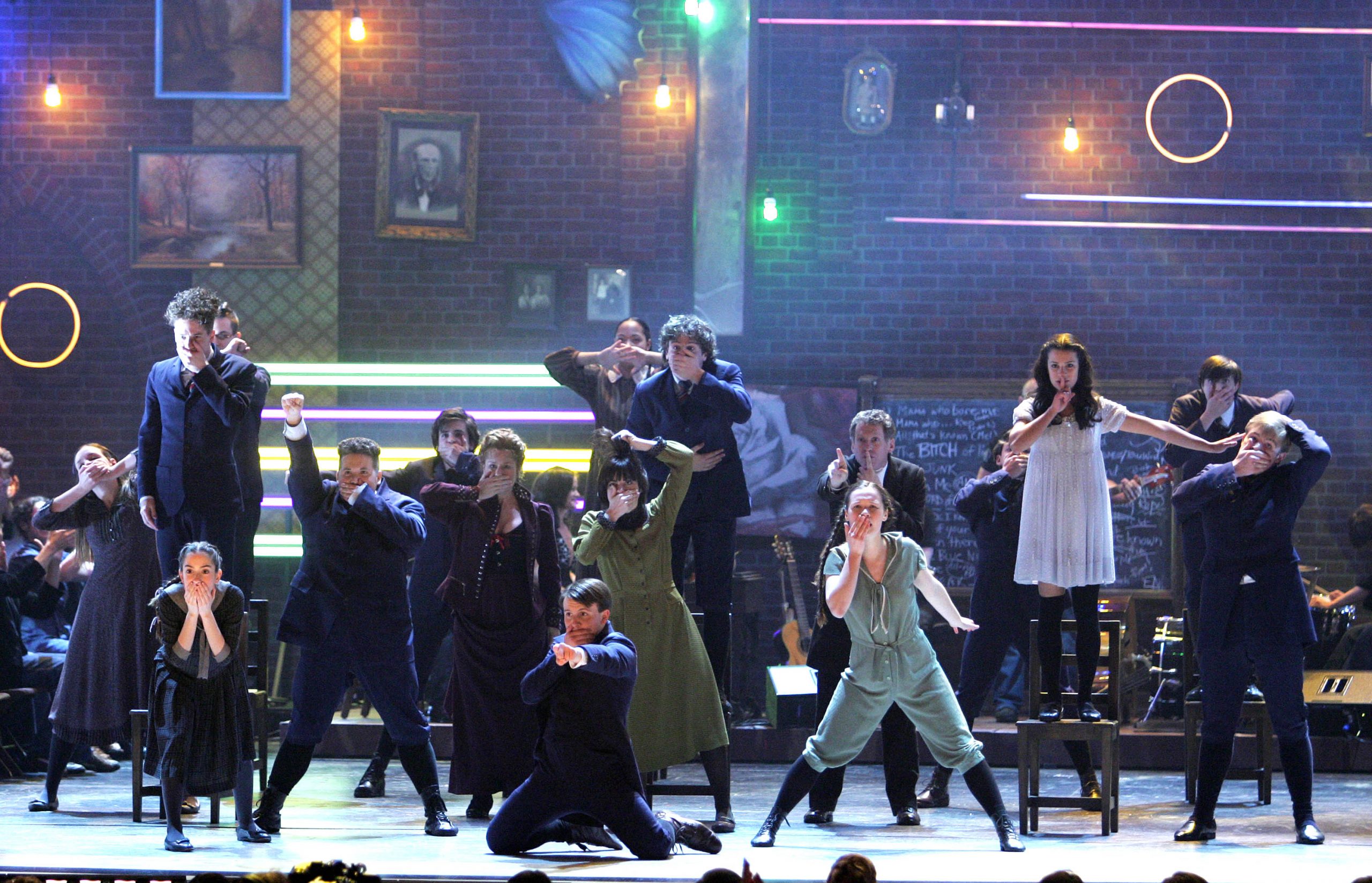
Period-clothed teenagers pulled out microphones, and their constrained world opened into contemporary music. The reviews captured the excitement of that encounter. Charles Isherwood’s Broadway review in The New York Times suggested that Broadway “may never be the same.” The Observer’s John Heilpern called it “the best new musical I’ve seen in a generation.” 28 29
The transfer itself gave critics something to examine. Heilpern felt that the larger production preserved its intimacy and integrity while raising its artistic achievement. Time Out’s Adam Feldman praised revisions that improved clarity and focus, but found the intensity harder to sustain in a larger theatre, where uncomfortable laughter could interrupt the tension. 29 9
Those responses reveal a creative challenge that continued even after the musical found its audience: how to carry a fragile, intimate experience into a bigger room. In 2007, Spring Awakening won eight Tony Awards. 10
The opportunities it created extended well beyond opening night. Groff earned his first Tony nomination as Melchior, later appearing in Hamilton and winning a Tony for Merrily We Roll Along. Michele’s Wendla preceded her television fame in Glee and her Broadway return in Funny Girl. Gallagher won a Tony for Moritz, while fellow original cast member Skylar Astin went on to Pitch Perfect. The musical helped bring a remarkable group of young performers to wider attention. 14 15 10 16
New artists gave the musical another life
The work kept travelling. Its original Broadway production and 2015 revival together recorded 886,425 admissions. That Broadway total represents visits, including repeat attendance; it leaves out the musical’s tours and productions elsewhere. By 2015, it had already been produced in more than twenty countries. 17 18
One of its most consequential reinventions began in a 99-seat Los Angeles theatre in 2014. Directed by Michael Arden, Deaf West Theatre’s production brought Deaf, hard-of-hearing, and hearing artists together, performing simultaneously in American Sign Language and spoken and sung English. It grew into a larger production at the Wallis Annenberg Center before reaching Broadway in 2015. 18 19
That reinvention required its own development. Artistic director DJ Kurs described hours spent examining Sater’s poetic lyrics to translate their meanings clearly. Sign language and choreography had to work together while keeping the language understandable. 18
Arden also brought the historical suppression of sign language into the classroom scenes. The story’s concern with young people denied understanding acquired another dimension, rooted in Deaf experience. 20
The production opened further doors. Ali Stroker made Broadway history as its first performer who uses a wheelchair, later winning a Tony for Oklahoma!. Daniel Durant, its Moritz, went on to appear in CODA. 3 21 22
The support behind the breakthrough
The full reach of a musical includes the people who perform it, the artists who reinterpret it, and the listeners who carry its songs into their lives. Spring Awakening gave generations of young people a way to encounter difficult feelings in a shared space. Its successive productions continue to offer artists opportunities to make that encounter their own.
Duncan Sheik’s untimely death on September 17, 2026, at age 56, gives that journey a particular poignancy. The composer helped create a musical whose life would extend far beyond its original production, through new interpretations, the careers it helped propel, and the people who found something of themselves in its songs. 11
Remembering Sheik brings us back to the original act of creation: one writer asking a friend to imagine what an old play might become. That work survived through a succession of people and institutions willing to give it another opportunity.
That is why development matters to the National Foundation for Musical Theatre. The years when a work is still being rewritten, still searching for a home, and still difficult to explain are years when support can make a difference. Paying artists, providing rehearsal time, and helping a musical reach listeners give its creators a chance to discover what it can become.
The audiences, careers, and new interpretations that followed Spring Awakening began with people willing to help it take the next step.